
Digital Attention vs Human Attention: What Are We Losing?
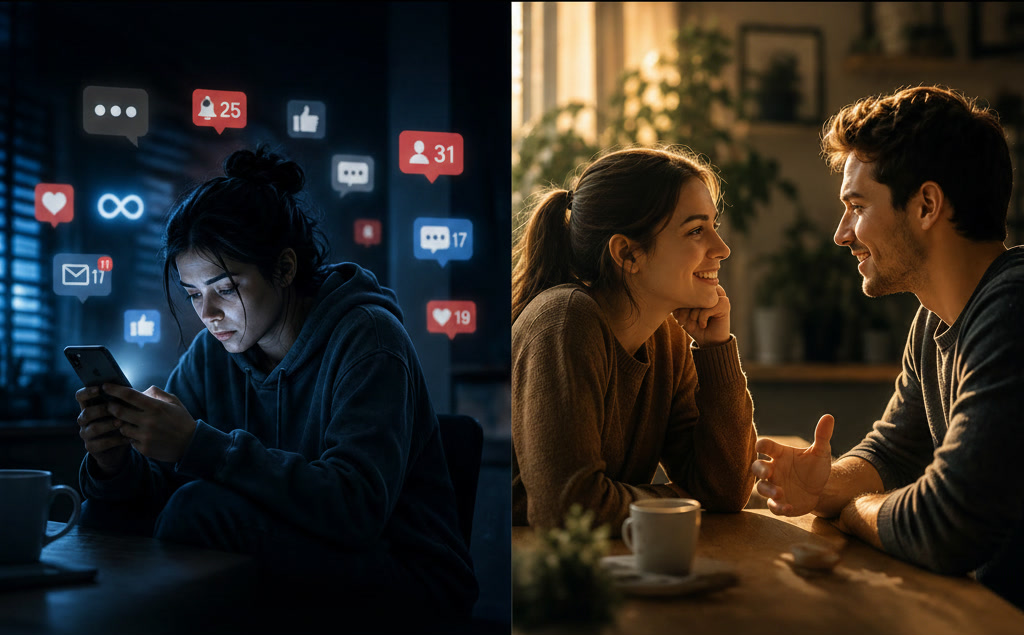
Attention is one of the most valuable things we have.
Every day, we decide—often without realizing it—what deserves our attention. We pay attention to a conversation, a book, a lesson, a task, a person’s expression, or our own thoughts. Where our attention goes, much of our experience follows.
But the digital world has changed the way we use this limited resource.
We now move between messages, videos, websites, notifications, headlines, advertisements, and endless streams of information within seconds. The modern digital environment is designed to keep us engaged, constantly offering something new to look at.
This creates an important question:
As digital attention becomes more demanding, what happens to our ability to give genuine attention to the world around us?
The issue is not simply that we spend time online. The deeper concern is that constant digital stimulation may change what our minds expect from everyday life.
Attention Is More Than Looking
Attention is often misunderstood as simply noticing something.
True attention is deeper. It means allowing your mind to stay with something long enough to understand it.
When you listen carefully to someone, read a difficult chapter, learn a new skill, solve a problem, or observe your surroundings, your mind needs continuity. It needs enough uninterrupted time to process what is happening.
Digital environments often work differently.
They encourage movement.
One piece of content leads to another. One topic quickly becomes another. A short video is replaced by another before we have had time to think about the first one.
This constant movement can make sustained attention feel unusually demanding.
The Rise of Fragmented Attention
Imagine trying to complete a task while your attention is divided into several directions.
You are working on a report, listening to music, checking a message, reading an email, looking at a notification, and occasionally browsing something unrelated.
You may technically be doing all of these things, but your attention is constantly being redirected.
This is known as fragmented attention.
The problem with fragmentation is that the mind does not process every activity equally well at the same time. Switching between tasks can make thinking feel less organized and can make complex activities take longer.
Digital technology makes switching extremely easy.
With a few taps, we can move from work to entertainment, from conversation to news, or from learning to completely unrelated content.
The ability to switch is useful—but always switching is different from being flexible.
What Happens to Deep Thinking?
Some ideas cannot be understood in a few seconds.
A difficult subject, an important decision, a personal problem, or a complicated creative project requires time. The mind needs space to connect information, question assumptions, and explore possibilities.
Deep thinking is rarely instant.
It often begins with confusion.
You read something and do not understand it immediately. You think about it. You return to it. You make connections. Slowly, the idea becomes clearer.
A digital environment filled with constant stimulation can make this process harder because the moment something becomes difficult, there is always an easier distraction available.
Instead of staying with the difficult thought, we can simply move on.
Creativity Needs Empty Space
Creativity is not always produced by consuming more information.
Sometimes, it appears when the mind has room to wander.
Ideas can emerge while walking, waiting, observing people, looking out of a window, or simply doing nothing for a few minutes. These moments may seem unproductive, but they give the brain an opportunity to make unexpected connections.
When every quiet moment is immediately filled with digital content, there may be less room for this kind of mental wandering.
Constant input leaves little space for internal output.
We consume information all day, but creativity often requires stepping away from information long enough to process it.
The Disappearance of Boredom
Boredom has developed a bad reputation.
The moment we feel bored, we often reach for something to entertain us. A video, a game, a social platform, or an article can instantly remove the uncomfortable feeling.
But boredom can have a useful side.
When there is nothing demanding our attention, the mind begins looking inward. We think about things that happened earlier. We imagine possibilities. We notice our surroundings. We may even discover that we are carrying emotions or questions we have been avoiding.
Without moments of mental quiet, we can become highly entertained without necessarily becoming more reflective.
The ability to sit with boredom is therefore more valuable than it may appear.
Are We Losing the Art of Listening?
Human attention is not only about concentration on tasks. It is also about other people.
Listening to someone properly requires patience. You need to hear their words, understand their meaning, notice their tone, and recognize what they may be trying to communicate beyond what they actually say.
Digital communication often encourages quick responses.
We react. We reply. We move on.
But meaningful listening takes longer.
When people become accustomed to rapid digital interactions, slower conversations can sometimes feel uncomfortable. There may be a temptation to interrupt, finish someone’s sentence, or mentally prepare a response instead of simply listening.
Attention is an important part of empathy.
If we are not willing to give someone our attention, it becomes harder to understand their experience.
Observation Is Becoming a Lost Skill
Look around a busy public place and notice how many people are looking at screens.
People waiting for transportation, sitting in cafés, walking through public spaces, or waiting for appointments often have immediate access to digital entertainment.
There is nothing wrong with using a phone during these moments.
But constant screen engagement can reduce opportunities for observation.
When we look around, we notice architecture, expressions, sounds, weather, movement, and small details that would otherwise pass unnoticed.
These observations contribute to our understanding of the world.
A mind that is always occupied may have less opportunity to notice what is happening around it.
Digital Information Is Not the Same as Knowledge
We have access to more information than any previous generation.
A question can be searched in seconds. A tutorial can teach a new skill. A news story can reach millions of people almost instantly.
Yet information and understanding are not the same thing.
Understanding requires processing.
It requires asking whether something is accurate, connecting it with previous knowledge, considering different perspectives, and sometimes sitting with uncertainty.
The speed of digital information can create the illusion that because we have seen something, we understand it.
But seeing hundreds of pieces of content does not necessarily mean learning from them.
Sometimes, knowing less but understanding it deeply is more valuable than knowing a little about everything.
The Cost of Constant Stimulation
The digital world offers convenience, entertainment, and connection, but it also creates an environment where stimulation is almost always available.
This can change our expectations.
A slow book may feel too slow.
A long conversation may feel difficult.
A complicated task may feel frustrating.
A quiet afternoon may feel empty.
The issue is not that these activities have suddenly become worse. Our tolerance for slower experiences may simply have changed.
Human attention evolved to move between periods of activity and rest. Digital environments can blur that boundary by making stimulation available almost everywhere.
Reclaiming Human Attention
Protecting attention does not require abandoning technology.
Instead, it requires becoming intentional about where attention goes.
Create periods for focused work where unnecessary digital interruptions are removed. Read something without switching to another application. Have conversations where both people are fully engaged. Spend time outdoors without needing to document it.
Most importantly, allow moments of doing nothing.
A few minutes of silence may initially feel uncomfortable, especially when the mind is accustomed to constant input. But gradually, quiet becomes less threatening.
It becomes space.
Space to think.
Space to observe.
Space to remember.
Space to create.
Choosing Depth in a Fast Digital World
Digital technology rewards speed.
Human understanding often rewards depth.
The fastest response is not always the most thoughtful one. The most popular information is not always the most valuable. The largest amount of content is not necessarily the best source of knowledge.
There is still enormous value in slowing down.
Reading one book carefully can teach more than scrolling through hundreds of quotes. Listening to one person deeply can reveal more than watching countless relationship videos. Spending an hour developing one skill can be more meaningful than consuming an endless stream of productivity advice.
The goal should not be to reject digital life, but to make sure it does not completely determine the pace of our thinking.
What Are We Really Losing?
Perhaps what we risk losing is not attention itself, but depth.
Depth in thinking.
Depth in conversations.
Depth in learning.
Depth in relationships.
Depth in experiencing ordinary life.
Technology gives us incredible access to information and people. But human attention remains limited. Every minute spent looking at one thing is a minute that cannot be given to something else.
That makes attention a form of choice.
If we constantly give it to whatever demands it most loudly, we may have less left for the things that matter quietly.
Digital technology has made the world faster, more accessible, and more connected to information than ever before. But speed and accessibility should not come at the cost of our ability to concentrate, reflect, listen, observe, and think deeply.
Human attention needs more than stimulation.
It needs silence. It needs patience. It needs curiosity. It needs uninterrupted moments.
The challenge of the digital age is therefore not simply learning how to use technology.
It is learning when not to give it our attention.
Because what we repeatedly focus on does more than fill our time.
It shapes the way we think, the way we experience the world, and ultimately, the way we live.