
Are We Living for Social Media Instead of Living in Real Life?
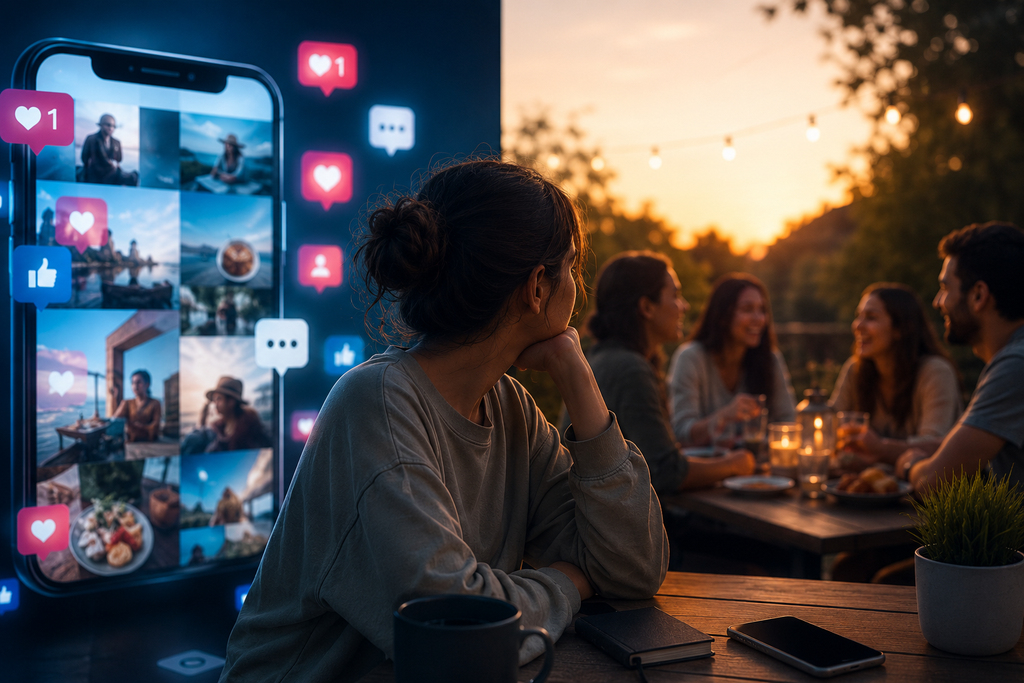
Imagine going somewhere beautiful for the first time. Before enjoying the view, you take a photograph. Before tasting the food, you capture it. Before laughing with friends, someone suggests recording a video. Later that evening, you spend time choosing the best picture, writing a caption, adding music, and checking how people respond.
The experience happened in real life.
But somehow, documenting it became almost as important as experiencing it.
Social media has become deeply woven into modern life. It allows us to express ourselves, stay informed, discover new ideas, build communities, and share important moments with others. Yet there is an increasingly important question worth asking:
Are we using social media to share our lives, or are we slowly shaping our lives around social media?
When Every Moment Becomes Content
Not every experience used to require an audience.
A birthday, a trip, a meal, a new outfit, a sunset, or a simple gathering could exist simply as a personal memory. Today, many of these moments are immediately considered potential content.
The camera comes out before the experience has even settled in.
This does not mean taking photographs is wrong. Photos can preserve memories and allow us to share meaningful moments with people who are far away.
The problem begins when documenting an experience becomes more important than experiencing it.
Instead of asking, “Am I enjoying this?”, we may unconsciously start asking, “Will this look good online?”
That small change can influence the way we make decisions, choose places, dress, travel, and even celebrate.
The Pressure to Look Interesting
Social media creates a strange expectation: our lives should always appear interesting.
A normal day can suddenly feel inadequate when we constantly see other people’s vacations, achievements, celebrations, new purchases, social events, and carefully arranged lifestyles.
The reality is that social media rarely shows an entire life.
It shows selected moments.
Someone may post a photograph from an amazing trip without showing the stressful journey behind it. Someone may share career success without discussing years of uncertainty. A perfect-looking relationship post may reveal nothing about the disagreements happening privately.
When we compare our complete reality with someone else’s edited presentation, our own lives can feel less exciting than they actually are.
Living for Validation
One of the strongest influences of social media is the desire for recognition.
A post receives likes, comments, shares, or positive reactions, and we experience a sense of approval. When engagement is lower than expected, disappointment can follow.
This can gradually create a habit of measuring experiences through other people’s reactions.
A photograph may feel more valuable when it receives hundreds of likes. A personal achievement may seem more meaningful when others congratulate us publicly. A creative idea may feel unsuccessful simply because it did not attract attention.
But personal value should not depend entirely on digital response.
Some of the most meaningful moments in life may never receive a single like.
A conversation with someone you love, helping a friend through a difficult day, watching a sunset alone, learning something new, or achieving a private goal can all be deeply important without becoming content.
FOMO and the Fear of Missing Out
Social media has made other people’s activities visible almost all the time.
You can see friends attending events you were not invited to, travelling to places you have never visited, or enjoying experiences you were not part of.
This can create FOMO—the fear of missing out.
Instead of being satisfied with where we are, we begin thinking about where we could be.
A quiet weekend may feel boring because someone else’s weekend looks exciting online. Staying home may feel like missing life. Not attending an event may seem like being left behind.
The strange part is that social media can make us aware of experiences we never knew existed—and then make us feel unhappy for not having them.
The Performance of Happiness
Another problem is the pressure to appear happy.
People naturally share positive moments, but social platforms can encourage a polished version of happiness. Smiling photographs, celebrations, inspirational captions, and exciting updates can create the impression that life should always look beautiful.
This can make ordinary emotions feel unacceptable.
Being tired, uncertain, bored, disappointed, or confused is a normal part of being human. Real life contains these emotions, even when social media does not.
When people constantly feel pressure to present themselves positively, they may begin hiding what they genuinely experience.
Eventually, there can be a gap between how life feels and how life looks.
When Experiences Become Performances
Think about attending a concert.
Instead of simply listening to the music, someone may spend much of the performance recording clips for social media.
Think about eating at a restaurant.
Instead of enjoying the meal, the first concern may be getting the perfect photograph.
Think about travelling.
Instead of exploring freely, the itinerary may be influenced by places that look impressive in photographs.
When this happens, experiences can become performances.
We are no longer only living the moment. We are also imagining how the moment will appear to an audience.
That invisible audience can influence our choices even when nobody is actually watching.
The Difference Between Memory and Documentation
Modern technology gives us the ability to document almost everything.
Our phones can store thousands of photographs and videos. But having a record of a moment is not the same as remembering how it felt.
Sometimes, taking fewer photographs can actually help us become more attentive to an experience.
When we stop worrying about capturing every detail, we may notice things that a camera cannot fully record—the sound of a place, the atmosphere of a conversation, the feeling of being surrounded by people we care about, or the quietness of a particular evening.
A photograph preserves an image.
Presence preserves an experience.
Social Media Can Influence Our Identity
Social platforms also affect how we present ourselves.
We choose profile pictures, captions, interests, opinions, photographs, and even the people we follow. Over time, this collection becomes a kind of digital identity.
The danger is that we may start shaping ourselves according to what receives attention.
If a particular style gets more engagement, we may post more of it. If certain opinions are popular, we may feel pressure to express them. If a particular personality receives positive reactions, we may begin performing that personality ourselves.
The question becomes:
Who are we when there is no audience?
That question is important because a healthy identity should exist beyond a profile.
Are We Missing the Present?
One of the greatest costs of living for social media is that the present can become secondary.
We may constantly think about capturing the next moment instead of enjoying the current one.
A meal becomes a photograph.
A trip becomes a collection of posts.
A celebration becomes a story.
A personal achievement becomes an announcement.
There is nothing inherently wrong with sharing these things. The concern is whether sharing has become necessary for the experience to feel complete.
Life should not need to be posted to be valuable.
Learning to Use Social Media Without Living Through It
The answer is not necessarily deleting every social-media application.
Social media has genuine benefits. It helps people discover opportunities, maintain communities, promote businesses, express creativity, and connect across geographical boundaries.
The healthier approach is to create a distinction between sharing life and performing life.
Enjoy an experience before documenting it.
Take photographs because you want to remember something, not only because you want approval.
Keep some moments private.
Celebrate achievements even when nobody online knows about them.
Spend time doing things that have no obvious content value.
Read a book without photographing it. Go for a walk without turning it into a story. Meet someone without thinking about what you could post afterward.
These simple choices can remind us that life does not need an audience.
A Life That Exists Beyond the Screen
Social media is a tool, but it becomes a problem when it starts becoming the measurement of a successful life.
Followers are not friendships.
Likes are not self-worth.
Views are not memories.
And a beautiful feed is not proof of a beautiful life.
A meaningful life is built through experiences that may never appear online: relationships, personal growth, failures, ordinary routines, private achievements, difficult lessons, and moments that belong only to us.
The most important parts of life often happen when nobody is recording.
Social media has changed the way we present ourselves and experience the world. It has made sharing easier, but it has also introduced a new pressure to make life look worth sharing.
The challenge is not whether we should use social media.
The challenge is whether we can use it without allowing it to define how we live.
Take the photograph. Share the celebration. Post the achievement.
But sometimes, leave the phone in your pocket.
Enjoy the meal without photographing it. Watch the sunset without turning it into a story. Laugh with your friends without worrying about recording the moment.
Because a life does not become meaningful when other people see it.
It becomes meaningful when you actually live it.